stress corrosion cracking

Question:  “Please see attached pictures of the inside of my tanks.  What is causing the pitting in this area?”

Tank Guru:  I suspect that the reason for this damage may be chloride stress corrosion.  Chlorides are a problem for 300 series grades of stainless steel, such as 304 or 316 (most common in tank containers), and stress corrosion cracking can occur when you have the simultaneous presence of tensile stresses along with specific environmental factors such as having a steam-heated/insulated tank.  Most insulation contains chlorides, especially polyurethane, and so it is usually advisable to not have this type of insulation in direct contact with the barrel when the tanks are going to be steam-heated.  Chloride stress corrosion is an increased risk with temperatures above 125° F.  The tensile stresses could be the result of certain operations to the tank, or due to residual stress from the fabrication process such as bending and/or welding.  I think this is why you are seeing the corrosion problem between the head seam and knuckle radius.
painting tank frames and barrels

Question:  “What types of paint coatings should we put on our tank containers?”

Tank Guru:  The industry standard for ocean-going containers is a zinc-rich epoxy primer on any steel surfaces, like the framework on a tank container, followed by a top coat.  It goes without saying that surface preparation is everything, so first the steel surfaces must be abrasive-blasted or otherwise suitable prepared to receive the primer coat.  Follow the coating manufacturer’s instructions for thinning (if necessary), application thicknesses, re-coat times, etc.

A good acrylic enamel top coat, compatible with the primer coat and applied to customer color, should be all that is needed afterward.  These provide the best corrosion resistance in general and are used througout the conainer industry and available in a variety of colors.  A polyurethane top coat can also be used providing acceptable corrosion resistance and much better gloss retention.

A link to the RAL color codes is provided below.  If painting frame and barrel (stainless steel), then a different procedure would be used.  You are welcome to contact me with any further questions.

http://www.ralcolor.com/

decals

Question:  “Can I install new decals on top of old decals?”

Tank Guru:  When it comes to the regulatory markings on a container, what is typically specified in various regulations is the size of the required markings and their location; NOT the manner in which they are installed.  There is no rule stating that one cannot install a new decal on top of an old decal.   That said, there is no reason that it wouldn’t be better to first remove the old decal. 

But, if for example the old decal is faded or illegible due to years of sun exposure and likewise adhered to the cladding because of being baked on by the sun and therefore difficult to remove; then I suppose you could install the new decal on top of the old one.  Just make sure that the new decal is securely affixed and easy to read (old decal does not show through).  Thanks for the question.

gaskets

Question:  “What measurments do you need to make gaskets?  Is it just the diagonal bolt pattern and the size of the opening?”

Tank Guru:  Usually what we need to make gaskets is the Outside Diameter, Inside Diameter, and thickness of the gasketing material regardless of whether it is a ring gasket or a full-face gasket.  Then for full-face gaskets we also need to know the number and size of the bolt holes, and the Bolt Circle Diameter.  For instance, we might spec out a 3” ANSI 150# gasket this way: 

7.5” OD x 3.5” ID x 1/8” thick full-face gasket with 4x ¾” holes, equally-spaced on a 6” BCD.

more on food-grade tanks…

I had another question today about used food-grade tanks.  Now, “food-grade” can mean different things to different people — from sanitary tanks (with a polished interior) for milk or like products where bacteria is a concern, to tanks for ‘food-grade’ phosphoric acid or some other hazmat material.

But generally speaking in the intermodal tank world, a food-grade tank is simply a stainless steel tank container with a factory 2B finish that has never carried any chemical product, only edibles such as wine and spirits, corn syrup, etc. (not fish oil).

The issue is that if you want to purchase a food-grade tank, normally you will be buying a new tank rather than a used tank.  Reason being that at some point in the life cycle of a typical used tank, it was introduced into chemical service, especially here in the United States (transport of food products in tank containers is much more common in Europe) and therefore can no longer be considered food-grade.

So the question I got today was whether there are any options besides buying a new tank, and the answer is YES.  We have a process where we can take an ex-chemical tank, strip it of all valves and fittings and thermally clean it (heating interior to bake out impurities), then sandblast the interior and coat all wetted surfaces with a lining that is FDA approved for direct food contact.  Lastly we replace all valves with new stainless steel so that any wetted part is a virgin surface. 

This is a fairly expensive process, but still usually cheaper than purchasing a new tank, and of course involves less lead time than building a new tank.  So there you have it, “food” for thought!

food grade tanks

Question:  “Are food grade tanks exempt from hydro test, and are only leak tests required?”

Tank Guru:  This is an area of confusion for many people.  It always comes back to the product being shipped.  Since most edible products are non-hazardous, then a specification packaging is not required.  However, in the case of a tank container, then of course the requirements for CSC Safety Approval have to be met for the ‘container’ even if the tank itself is a non-Code vessel.  BUT, if shipping the non-hazardous material in a spec packaging such as an IMO 1, IMO 2, or UN Portable Tank; then the certifications (and associated testing requirements) should be maintained, or else the tank should be down-graded to a non-spec packaging.  In the case of a non-spec tank, obviously there would be no requirement for a hydro test.

Keep in mind that some food grade products are still considered hazmat (certain alcoholic beverages might ship as a Class 3 flammable liquid, for instance); and in that case one would need to refer to the MSDS for details on the authorized packagings.

rubber linings

Question:  Do you have any idea what a rubber lined IMO 1 would have cost before 2000 ex USA?  Carbon steel, 4 bar MAWP, 20,000 liter, manufactured in 1992 by Zenith Engineering in Singapore.”

Tank Guru:  The best estimate that I can give you is somewhere between $35,000 – $50,000 USD.  It would depend on a number of factors, including the number and type of valves (lined?), the thickness and grade of rubber used in lining the tank interior, whether the tank also carried IM-101 (3/8″ wall thickness for AAR-600) approval, etc.  But it would have definitely been more expensive that a standard stainless steel IMO 1.   Hope this helps.

container size and type codes

Question:  “Some of my tanks say T6 and some say T8.  What is the correct marking?”

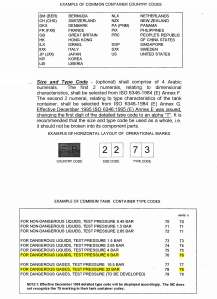
Tank Guru: If you are referring to the “Type Code” of the tank container, as in 22T6 or 22T8, it will depend on the pressure rating of the tank.  For a typical 4 bar MAWP chemical tank with a Test Pressure of 6 bar, the correct code would be T6 and would be appropriate for any tank with a Test Pressure equal to or greater than 6 bar, but less than 10.5 bar.

T8 (or 22T8) would normally be found on gas tanks.  And in the Size Code the first “2” indicates that it is a 20′ container, and the second “2” indicates the 8.5′ height.  See attached a more detailed explanation, courtesy of the now-defunct Tank Container Association.

container size and type codes.pdf

tank re-testing requirements

Question:  How often and what are the procedures for retesting an ISO container. (Pressure and thickness)” 

Tank Guru:  Hazardous materials may only be carried in tank containers (ISO tanks) that have a valid, current 5-year or 2.5-year test certificate.

A 5-year periodic test is required 60 months after the date of the original hydrostatic test, or the most recent subsequent 5-year test.  The scope of the test must include a hydrostatic pressure test at the tank’s full Test Pressure, usually 150% of the Maximum Allowable Working Pressure.  It will also include a visual interior inspection of the tank barrel, and exterior inspection of the container to ensure structural integrity of the frame and safety items such as the catwalk.  A bench test of the safety relief valve is required along with a final leakage test (after the water has been drained and the relief valve re-installed), to ensure satisfactory operation of all service valves and equipment.  All of these tests are carried out under the witness of a surveyor/inspector for a third party agency or Class Society, which will issue the test certificate and stamp the new test date on the tank’s data plate.

A 5-year test is also required at any time when welding operations have been conducted on the shell.

At the midpoint between each 5-year test interval, a 2.5-year test is required 30 months after the most recent hydrostatic test.  This will include the exact same scope of testing/inspection as the 5-year test, except that the tank will not be hydrostatically tested.  Instead only the leakage test (pneumatic) is conducted at normal operating pressure.  Again all testing is carried out under the witness of the third party surveyor, and after successful completion the data plate is stamped and a test certificate is issued by the Class Society or competent authority.

There are no specific requirements for checking the thickness of the tank shell.  However, the thickness should be checked by using a UT meter whenever there is reason for concern that the thickness may have been compromised by corrosion, or repairs to the pitting such as excessive grinding, etc. 

cladding for insulation required under Special Provision TP38

Question:  Do we need to use stainless steel cladding when insulating tanks with 4″ insulation (as required for PIH products)?”

Tank Guru:  The insulation requirement for toxic products which are considered an inhalation hazard (special provision TP38) is as follows:  “Each portable tank must be insulated with an insulating material so that the overall thermal conductance at 15.5 °C (60 °F) is no more than 1.5333 kilojoules per hour per square meter per degree Celsius (0.075 Btu per hour per square foot per degree Fahrenheit) temperature differential. Insulating materials may not promote corrosion to steel when wet.”

In the simplest terms, 100mm (4″) of any of the normal insulating materials used on tank containers (mineral wool, fiberglass, polyurethane, etc.) more than meets the requirement.  And while it is most common to see tanks carrying PIH products with SS cladding, this is not required and any jacketing material will work.