Owner’s name

Question:  “We don’t want our company’s name on the tank container, because the cargo transported is very hazardous.  Can we just leave it off the data plate?” 

Tank Guru:  Nope, sorry.  Under 49CFR §178.274 (Specifications for UN portable tanks), Sec. 178.274 (i)(2) requires that the name of the tank’s operator (or owner, in the case of owner-operated tanks) “must be marked either on the portable tank itself or on a metal plate firmly secured to the portable tank” such as the primary data plate.

On the one hand, it is understandable that you would want to avoid unnecessary exposure, but on the other hand if there is an incident involving your tank, it is important for the authorities to be able to know who to contact.

Video

TC Impact Approval

Question:  “I was wondering if you knew anything about the TC impact approved spec I saw recently stamped on tank containers?  I am trying to design into our new tracking device an impact monitoring capability.” 

Tank Guru:  Quoting from the UN Sub-Committee of Experts on the Transport of Dangerous Goods, the TC Impact Approved mark is “used to identify tank containers that are in compliance with a design that has been successfully tested at a test facility approved by the Canadian competent authority.”

What that means is that the tank container you saw (or more specifically, the prototype unit for that series of containers) was tested by the tank’s manufacturer for use on Canadian railroads, by virtue of completing of a rail impact test like this:  https://www.youtube.com/watch?v=yWeDwE_7gNU.

Once testing is completed successfully, the Class Society issuing the design approval on behalf of the manufacturer will send to Transport Canada (http://www.tc.gc.ca/) a “pre-notification of intent to mark portable tanks” which outlines the tank numbers for the entire series of tanks to be marked with the TC Impact Approved marking.  Tank containers are not allowed to be transported on Canadian railroads unless their capability to withstand impacts has been proven by this testing, and they must be marked accordingly.

container unit number prefixes

Question:  “How do we create our own prefix for our container unit numbers?” 

Tank Guru:  Container prefixes, whether for tank containers or standard dry van containers, need to be registered with B.I.C. (the Bureau International des Containers et du Transport Intermodal) in Paris, France.  Their website is http://www.bic-code.org and it outlines the reasons for the globally recognized numbering system, as well as the process to register your own code.  The registration form for that can be found here:  http://www.bic-code.org/images/file/Formulaires/7%206%201.pdf

Also on the B.I.C. home page is a link to a neat little check digit calculator.  Once you register your 4-digit Alpha prefix and decide on the 6 numeral digits that you will assign to your container (or series of containers), you can use their check digit calculator to complete the numbering system for your container(s) and mark them accordingly.  Click here for that:  http://www.bic-code.org/calculate-the-check-digit-online.html

Lastly, if you see a container with a prefix that you are not familiar with and want to know who the registered owner is, the B.I.C. website is again the place to go.  Use this link (http://www.bic-code.org/consultation-of-the-containers-bic-code-register.html) to search by prefix.  For instance, type in “ZIPU” in the Code box and click “send” and this is the result you will get!  http://www.bic-code.org/container-bic-code-zipu.html

80% filling ratio

Question:  “We have a customer that wants to load a 1.17 SG product in 24000 liter tanks.  Because the product will solidify in transport as it cools, a representative from one of the Class Societies said it would be OK. 

The problem we see is that once the product arrives overseas and is heated at a depot prior to being delivered to the customer, it will no longer be solid and we believe it will no longer meet the viscosity requirements in IMDG 4.2.1.9.6 that allow you to ignore the 80% fill rule.  But the Class Society representative says that the IMDG viscosity criteria is at 20° C, and since we are having to heat the product above 20° C in order for it to be viscous, therefore we are in luck.”

Tank Guru:  His logic makes sense; however it sounds like complying with the letter of the law but not the spirit of the law.  If the rule is there to prevent a dangerous slosh and surge situation, but you dodge the rule because ‘had the product been cooler it would have been less volatile’ — then good luck defending that position in a court of law if there is a rollover accident resulting in death or injuries.

I think you should convince your customer to use 21000 liter tanks, which will generally have a lower tare weight than larger tanks, and allow for slightly more payload anyway.      #CommonSenseSafety

Image

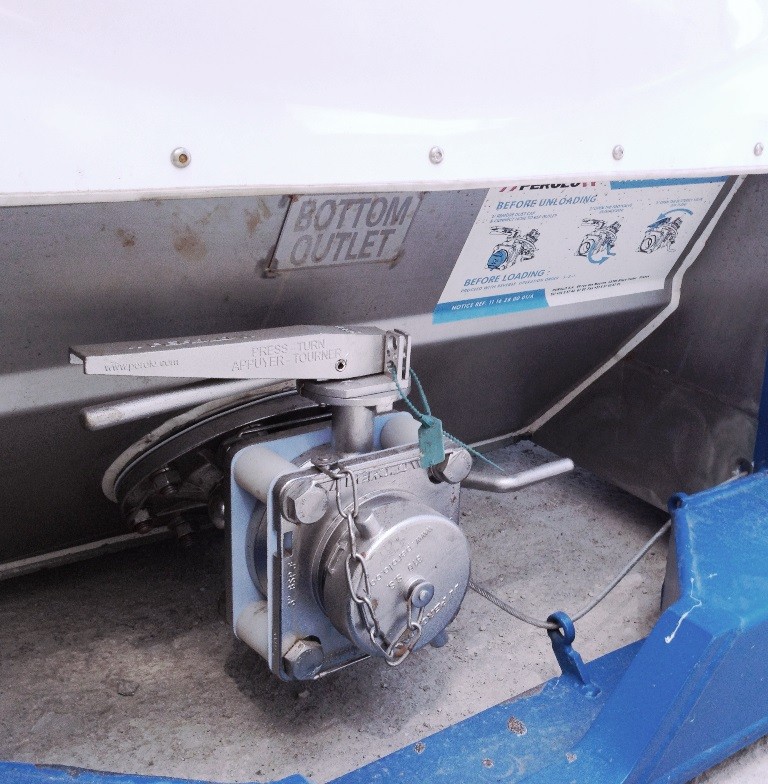
bottom discharge fittings

traditional bottom outlet valve arrangement with 3" BSP cap

traditional bottom outlet valve arrangement with 3″ BSP cap

Question:  “An IMO-1 we purchased is going to Venezuela with product in it.  I heard that it cannot ship with the camlock and cap on the outlet valve.  Can you clarify for me what is accepted?  One of our employees wants to install a blind flange on the bottom and have it converted once it gets to the customer.  I am concerned that would be difficult and could end up with a leak.”

Tank Guru:  Unless the camlock fitting is sticking outside the ISO envelope, if can definitely ship on the tank (so long as fitted with the dust cap).

The regulatory requirement (for products that are authorized for transport in bottom outlet tanks) is that there be 3 points of closure for openings below liquid level.  One of these must be the self-closing internal valve.  The second is generally the external valve, usually a butterfly valve but sometimes a ball valve.  The third point of closure can be a blind flange or camlock dust cap; but is most typically a 3” BSP cap fitted to the outlet flange.  Hope that helps!

2012 in review…

The WordPress.com stats helper monkeys prepared a 2012 annual report for this blog.

Here’s an excerpt:

The new Boeing 787 Dreamliner can carry about 250 passengers. This blog was viewed about 1,400 times in 2012. If it were a Dreamliner, it would take about 6 trips to carry that many people.

Click here to see the complete report.

Pounds-per-Gallon rating

Question:  “On our tank trailers, we have a pound-per-gallon rating.  Is there a rating for this on our tank containers?  Do we have a maximum pound per gallon rating?”

Tank Guru:  There is a definitely a maximum cargo weight you can carry, but the terminology in the tank container industry is a little different from the tank trailer industry, at least in the U.S.

For a tank container it is based on the Maximum Gross Weight (MGW) of the tank.  For instance, on many new tanks the MGW is 36000 KG or 79,365 lbs.  If you subtract from that the tare weight of 7,500 lbs. for a representative 24000 liter T11 tank, you would have a Maximum Payload carrying capacity of 71,865 lbs.

So if you filled that 24000 liter tank to the minimum safe-transport level of 80% you would have a payload of 19200 liters or 5,072 gallons.  Therefore the cargo could weigh up to 14.169 lbs. per gallon (71,865/5,072).  Now, you could never legally scale a load that heavy, but if you could the tank could handle it.  So in theory, that would be the pound-per-gallon rating.  In actual practice, you will be shipping loads of lighter density products in 24000 liter tanks (and probably to a higher filling ratio), but you can still use the same math for any sized tank and its actual MGW (less its actual tare weight).  Or, you could even use 24000 liter tanks at a lower filling ratio if baffles are installed — but just don’t forget to include the weight of any added baffles to the tare weight of the tank (because of the reduction to the payload capacity).  Hope that helps!

grace period on 2.5-year (midpoint) inspection

Question:  “Is there a grace period on the 2.5 year test?”

Tank Guru:  Yes there is a grace period of 90 days before or after the test due-date for the 2.5-year periodic test.  For instance, if the last 5-year hydro test was performed in Jun-2008 and the 2.5-year test should have been performed in Dec-2010, you still have until Mar-2011 to carry out the periodic test.  This does not change the next test due-date, which will still be Jun-2013 (5 years after the last hydro test). If the 2.5-year test is not carried out by Mar-2011, then you would have to perform a full 5-year test to get the tank back into compliance.  Thanks for a great question.

box tanks and removable linings

Question:  “Have you ever heard of installing a flexible lining in a tank container?  I can think of reasons why this isn’t a particularly good idea.  I’ve also been asked recently why box tanks, like those made years ago by Hoyer and Hugonnet, couldn’t carry more cargo than a standard liquid tank.” 

Tank Guru:  I have indeed heard of installing a disposable liner inside of a tank container, but never seen it done.  One company I know tried it several years ago and ultimately determined that it wasn’t an effective solution, either because of installation difficulties or cost-effectiveness.  The reasons to install would be either to protect the tank from the cargo in the case of chemicals corrosive to stainless steel, or to protect the cargo from the tank such as shipping edibles as a backhaul in a chemical tank.

Box tanks were limited in capacity because most of the older 20′ boxes had a MGW of only 24000 KG to begin with, and additionally there is no point carrying a load larger than you could legally transport over the road without being overweight.

level gauges for portable tanks

Question:  “What are the possible alternatives of level gauges we could install on our T11 24000 liter tanks.  Would a Scully system work for this?”

Tank Guru:  Scully systems are mainly intended just as overfill protection (high-level alarm) and do not provide a continuous indication of the product level.  When considering level gauges, the options are somewhat limited on portable tanks because of the lack of electrical power, and the need to have something that will hold up to the rigors of transportation service (shock, vibration, etc.).  Not to mention that in a stainless steel chemical tank, most customers are going to want a gauge with all SS wetted parts.  

So there are basically 2 practical options: float gauges, and ultrasonic or radar technology.  There are a handful of float gauges available for transport tanks that vary from basic mechanical devices which have a long arm inside the tank with a stainless steel float that magnetically operates a simple dial (indicates percentage of tank volume); to a precision gauge where the float travels up and down a sender bar which is calibrated to display the actual volume of liquid inside the tank (either liters or U.S. gallons).   

Another option is the radar gauge, and as with the float gauge there are a couple of different ways you can go – either guided wave radar or microwave loop (non-contact).  There are pros and cons of one technology versus the other, and a lot of it depends on what will be transported in the tank and whether you have the ability to anchor the probe used in a guided wave system to the bottom of the tank; but in general one big advantage of radar systems over the float gauges is that there are no moving parts.  The disadvantage is that these systems typically cost more than a float gauge.