Category Archives: tank testing

Data Plates for UN Portable tanks (T11, T20, T22, T50)

Question:  “My tank is missing the data plate. What do I need to do in order to get another one?” 

Tank Guru: 

Each tank container used in international service needs to have the data plate that was affixed by the original manufacturer (or a replacement copy), a CSC Safety Approval plate, and a TIR/Customs plate.  The manufacturer’s plate includes key information regarding the design pressure and temperature, shell thickness, original hydro test date and last test date, and the approvals to which the tank was designed and constructed.  Additionally, for certain high-pressure tanks there might also be an ASME Code plate or a product plate that shows the list of substances approved for transport in the tank.

Most newer ISO tanks have a consolidated data plate that includes all of the manufacturer’s details as well as the CSC and TIR approvals.  If the data plate is lost or damaged in such a way that it’s not legible, you should affix a replacement plate that has been engraved with the original information — and then reviewed and stamped by the class society surveyor who carried out the last periodic test.  Replacement plates are available through tank container repair facilities or select parts suppliers:
http://www.perolousa.net/Combination_Replacement_Plate_for_MFG_DataCSCCustoms_-_8__x_20__Stainless_Steel/p733948_3684161.aspx

http://www.perolousa.net/Replacement_Plate_for_Manufacturers_Data_-_8__x_12__Stainless_Steel/p733948_3684051.aspx

http://www.perolousa.net/Replacement_Plate_for_TIRCustoms_-_4__x_8__Stainless_Steel/p733948_3684133.aspx

http://www.perolousa.net/Replacement_Plate_for_CSC_Safety_Approval_-_4__x_8__Stainless_Steel/p733948_3684080.aspx


Video

TC Impact Approval

Question:  “I was wondering if you knew anything about the TC impact approved spec I saw recently stamped on tank containers?  I am trying to design into our new tracking device an impact monitoring capability.” 

Tank Guru:  Quoting from the UN Sub-Committee of Experts on the Transport of Dangerous Goods, the TC Impact Approved mark is “used to identify tank containers that are in compliance with a design that has been successfully tested at a test facility approved by the Canadian competent authority.”

What that means is that the tank container you saw (or more specifically, the prototype unit for that series of containers) was tested by the tank’s manufacturer for use on Canadian railroads, by virtue of completing of a rail impact test like this:  https://www.youtube.com/watch?v=yWeDwE_7gNU.

Once testing is completed successfully, the Class Society issuing the design approval on behalf of the manufacturer will send to Transport Canada (http://www.tc.gc.ca/) a “pre-notification of intent to mark portable tanks” which outlines the tank numbers for the entire series of tanks to be marked with the TC Impact Approved marking.  Tank containers are not allowed to be transported on Canadian railroads unless their capability to withstand impacts has been proven by this testing, and they must be marked accordingly.

grace period on 2.5-year (midpoint) inspection

Question:  “Is there a grace period on the 2.5 year test?”

Tank Guru:  Yes there is a grace period of 90 days before or after the test due-date for the 2.5-year periodic test.  For instance, if the last 5-year hydro test was performed in Jun-2008 and the 2.5-year test should have been performed in Dec-2010, you still have until Mar-2011 to carry out the periodic test.  This does not change the next test due-date, which will still be Jun-2013 (5 years after the last hydro test). If the 2.5-year test is not carried out by Mar-2011, then you would have to perform a full 5-year test to get the tank back into compliance.  Thanks for a great question.

food grade tanks

Question:  “Are food grade tanks exempt from hydro test, and are only leak tests required?”

Tank Guru:  This is an area of confusion for many people.  It always comes back to the product being shipped.  Since most edible products are non-hazardous, then a specification packaging is not required.  However, in the case of a tank container, then of course the requirements for CSC Safety Approval have to be met for the ‘container’ even if the tank itself is a non-Code vessel.  BUT, if shipping the non-hazardous material in a spec packaging such as an IMO 1, IMO 2, or UN Portable Tank; then the certifications (and associated testing requirements) should be maintained, or else the tank should be down-graded to a non-spec packaging.  In the case of a non-spec tank, obviously there would be no requirement for a hydro test.

Keep in mind that some food grade products are still considered hazmat (certain alcoholic beverages might ship as a Class 3 flammable liquid, for instance); and in that case one would need to refer to the MSDS for details on the authorized packagings.

container size and type codes

Question:  “Some of my tanks say T6 and some say T8.  What is the correct marking?”

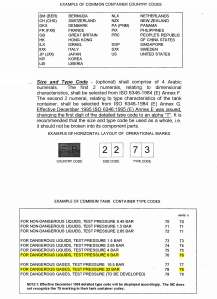
Tank Guru: If you are referring to the “Type Code” of the tank container, as in 22T6 or 22T8, it will depend on the pressure rating of the tank.  For a typical 4 bar MAWP chemical tank with a Test Pressure of 6 bar, the correct code would be T6 and would be appropriate for any tank with a Test Pressure equal to or greater than 6 bar, but less than 10.5 bar.

T8 (or 22T8) would normally be found on gas tanks.  And in the Size Code the first “2” indicates that it is a 20′ container, and the second “2” indicates the 8.5′ height.  See attached a more detailed explanation, courtesy of the now-defunct Tank Container Association.

container size and type codes.pdf

tank re-testing requirements

Question:  How often and what are the procedures for retesting an ISO container. (Pressure and thickness)” 

Tank Guru:  Hazardous materials may only be carried in tank containers (ISO tanks) that have a valid, current 5-year or 2.5-year test certificate.

A 5-year periodic test is required 60 months after the date of the original hydrostatic test, or the most recent subsequent 5-year test.  The scope of the test must include a hydrostatic pressure test at the tank’s full Test Pressure, usually 150% of the Maximum Allowable Working Pressure.  It will also include a visual interior inspection of the tank barrel, and exterior inspection of the container to ensure structural integrity of the frame and safety items such as the catwalk.  A bench test of the safety relief valve is required along with a final leakage test (after the water has been drained and the relief valve re-installed), to ensure satisfactory operation of all service valves and equipment.  All of these tests are carried out under the witness of a surveyor/inspector for a third party agency or Class Society, which will issue the test certificate and stamp the new test date on the tank’s data plate.

A 5-year test is also required at any time when welding operations have been conducted on the shell.

At the midpoint between each 5-year test interval, a 2.5-year test is required 30 months after the most recent hydrostatic test.  This will include the exact same scope of testing/inspection as the 5-year test, except that the tank will not be hydrostatically tested.  Instead only the leakage test (pneumatic) is conducted at normal operating pressure.  Again all testing is carried out under the witness of the third party surveyor, and after successful completion the data plate is stamped and a test certificate is issued by the Class Society or competent authority.

There are no specific requirements for checking the thickness of the tank shell.  However, the thickness should be checked by using a UT meter whenever there is reason for concern that the thickness may have been compromised by corrosion, or repairs to the pitting such as excessive grinding, etc.