Category Archives: tank specifications

container weights

Question:  “We mounted a mixer and some other equipment to our tank container.  This added equipment also added weight, so now the markings on the tank are incorrect.  What should I do?” 

Tank Guru:  Now that the International Maritime Organization (IMO) has introduced the Safety Of Life At Sea (SOLAS) regulations for Verified Gross Mass (VGM) of containers, there will continue to be increased scrutiny of container weights — especially when loaded, but also when empty.

It is key to have an accurate starting point, knowing what the empty weight of the container is before cargo is added.  If you have reason to believe that the actual weight of the container doesn’t match the tare (empty) weight that is stenciled on the tank, then we recommend re-weighing the tank.  First ensure that it is completely emptied of product, then have it weighed at a certified truck scale or comparable.  Once you know the weight, grind and re-stamp the data plate to correct both the tare weight and net payload, and replace any corresponding decal markings as well.

There are a lot of reasons that the tare weight on a tank container can change from its originally declared weight.  More common reasons include the installation of baffles, or the addition (or removal) of insulation and jacketing.  It is important that when changes are made, the markings are also updated accordingly.  People will make assumptions based on a container’s markings, and  improperly declared weights have been a factor in previous incidents involving ship safety.

Thanks for the question!
ISO dimensions

Question:  “We are going to set a concrete foundation for our tank container which we will use for storage purposes.  Is a 20′ ISO tank exactly 20′ long?  And what is the exact width?” 

Tank Guru:  Please see attached chart of ISO tank container dimensions.  You will note that a 20′ tank container is actually 19′-10.5″ long from end-to-end (6058 mm).  The overall width is 8′ (2438 mm) and both of these dimensions refer to the distance from the outside faces of the corner castings.

A standard tank container is considered a “1CC” shipping container as defined by ISO 668 (https://en.wikipedia.org/wiki/ISO_668).  Center-to-center of the holes in the bottom castings are 5853mm and 2259mm, respectively for length and width.

Good luck!  We sell a lot of these portable tanks into storage service, because it’s hard to find the same value for a stainless steel, pressure-rated tank.

Image

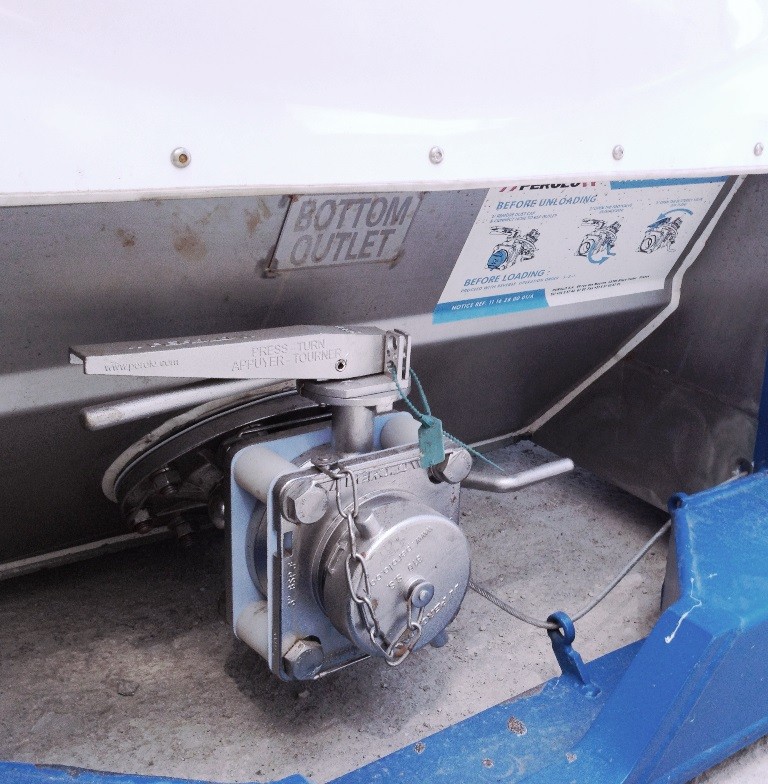
bottom discharge fittings

traditional bottom outlet valve arrangement with 3" BSP cap

traditional bottom outlet valve arrangement with 3″ BSP cap

Question:  “An IMO-1 we purchased is going to Venezuela with product in it.  I heard that it cannot ship with the camlock and cap on the outlet valve.  Can you clarify for me what is accepted?  One of our employees wants to install a blind flange on the bottom and have it converted once it gets to the customer.  I am concerned that would be difficult and could end up with a leak.”

Tank Guru:  Unless the camlock fitting is sticking outside the ISO envelope, if can definitely ship on the tank (so long as fitted with the dust cap).

The regulatory requirement (for products that are authorized for transport in bottom outlet tanks) is that there be 3 points of closure for openings below liquid level.  One of these must be the self-closing internal valve.  The second is generally the external valve, usually a butterfly valve but sometimes a ball valve.  The third point of closure can be a blind flange or camlock dust cap; but is most typically a 3” BSP cap fitted to the outlet flange.  Hope that helps!

Pounds-per-Gallon rating

Question:  “On our tank trailers, we have a pound-per-gallon rating.  Is there a rating for this on our tank containers?  Do we have a maximum pound per gallon rating?”

Tank Guru:  There is a definitely a maximum cargo weight you can carry, but the terminology in the tank container industry is a little different from the tank trailer industry, at least in the U.S.

For a tank container it is based on the Maximum Gross Weight (MGW) of the tank.  For instance, on many new tanks the MGW is 36000 KG or 79,365 lbs.  If you subtract from that the tare weight of 7,500 lbs. for a representative 24000 liter T11 tank, you would have a Maximum Payload carrying capacity of 71,865 lbs.

So if you filled that 24000 liter tank to the minimum safe-transport level of 80% you would have a payload of 19200 liters or 5,072 gallons.  Therefore the cargo could weigh up to 14.169 lbs. per gallon (71,865/5,072).  Now, you could never legally scale a load that heavy, but if you could the tank could handle it.  So in theory, that would be the pound-per-gallon rating.  In actual practice, you will be shipping loads of lighter density products in 24000 liter tanks (and probably to a higher filling ratio), but you can still use the same math for any sized tank and its actual MGW (less its actual tare weight).  Or, you could even use 24000 liter tanks at a lower filling ratio if baffles are installed — but just don’t forget to include the weight of any added baffles to the tare weight of the tank (because of the reduction to the payload capacity).  Hope that helps!

level gauges for portable tanks

Question:  “What are the possible alternatives of level gauges we could install on our T11 24000 liter tanks.  Would a Scully system work for this?”

Tank Guru:  Scully systems are mainly intended just as overfill protection (high-level alarm) and do not provide a continuous indication of the product level.  When considering level gauges, the options are somewhat limited on portable tanks because of the lack of electrical power, and the need to have something that will hold up to the rigors of transportation service (shock, vibration, etc.).  Not to mention that in a stainless steel chemical tank, most customers are going to want a gauge with all SS wetted parts.  

So there are basically 2 practical options: float gauges, and ultrasonic or radar technology.  There are a handful of float gauges available for transport tanks that vary from basic mechanical devices which have a long arm inside the tank with a stainless steel float that magnetically operates a simple dial (indicates percentage of tank volume); to a precision gauge where the float travels up and down a sender bar which is calibrated to display the actual volume of liquid inside the tank (either liters or U.S. gallons).   

Another option is the radar gauge, and as with the float gauge there are a couple of different ways you can go – either guided wave radar or microwave loop (non-contact).  There are pros and cons of one technology versus the other, and a lot of it depends on what will be transported in the tank and whether you have the ability to anchor the probe used in a guided wave system to the bottom of the tank; but in general one big advantage of radar systems over the float gauges is that there are no moving parts.  The disadvantage is that these systems typically cost more than a float gauge.

gaskets

Question:  “What measurments do you need to make gaskets?  Is it just the diagonal bolt pattern and the size of the opening?”

Tank Guru:  Usually what we need to make gaskets is the Outside Diameter, Inside Diameter, and thickness of the gasketing material regardless of whether it is a ring gasket or a full-face gasket.  Then for full-face gaskets we also need to know the number and size of the bolt holes, and the Bolt Circle Diameter.  For instance, we might spec out a 3” ANSI 150# gasket this way: 

7.5” OD x 3.5” ID x 1/8” thick full-face gasket with 4x ¾” holes, equally-spaced on a 6” BCD.

food grade tanks

Question:  “Are food grade tanks exempt from hydro test, and are only leak tests required?”

Tank Guru:  This is an area of confusion for many people.  It always comes back to the product being shipped.  Since most edible products are non-hazardous, then a specification packaging is not required.  However, in the case of a tank container, then of course the requirements for CSC Safety Approval have to be met for the ‘container’ even if the tank itself is a non-Code vessel.  BUT, if shipping the non-hazardous material in a spec packaging such as an IMO 1, IMO 2, or UN Portable Tank; then the certifications (and associated testing requirements) should be maintained, or else the tank should be down-graded to a non-spec packaging.  In the case of a non-spec tank, obviously there would be no requirement for a hydro test.

Keep in mind that some food grade products are still considered hazmat (certain alcoholic beverages might ship as a Class 3 flammable liquid, for instance); and in that case one would need to refer to the MSDS for details on the authorized packagings.