Category Archives: tank linings

box tanks and removable linings

Question:  “Have you ever heard of installing a flexible lining in a tank container?  I can think of reasons why this isn’t a particularly good idea.  I’ve also been asked recently why box tanks, like those made years ago by Hoyer and Hugonnet, couldn’t carry more cargo than a standard liquid tank.” 

Tank Guru:  I have indeed heard of installing a disposable liner inside of a tank container, but never seen it done.  One company I know tried it several years ago and ultimately determined that it wasn’t an effective solution, either because of installation difficulties or cost-effectiveness.  The reasons to install would be either to protect the tank from the cargo in the case of chemicals corrosive to stainless steel, or to protect the cargo from the tank such as shipping edibles as a backhaul in a chemical tank.

Box tanks were limited in capacity because most of the older 20′ boxes had a MGW of only 24000 KG to begin with, and additionally there is no point carrying a load larger than you could legally transport over the road without being overweight.
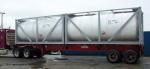
more on food-grade tanks…

I had another question today about used food-grade tanks.  Now, “food-grade” can mean different things to different people — from sanitary tanks (with a polished interior) for milk or like products where bacteria is a concern, to tanks for ‘food-grade’ phosphoric acid or some other hazmat material.

But generally speaking in the intermodal tank world, a food-grade tank is simply a stainless steel tank container with a factory 2B finish that has never carried any chemical product, only edibles such as wine and spirits, corn syrup, etc. (not fish oil).

The issue is that if you want to purchase a food-grade tank, normally you will be buying a new tank rather than a used tank.  Reason being that at some point in the life cycle of a typical used tank, it was introduced into chemical service, especially here in the United States (transport of food products in tank containers is much more common in Europe) and therefore can no longer be considered food-grade.

So the question I got today was whether there are any options besides buying a new tank, and the answer is YES.  We have a process where we can take an ex-chemical tank, strip it of all valves and fittings and thermally clean it (heating interior to bake out impurities), then sandblast the interior and coat all wetted surfaces with a lining that is FDA approved for direct food contact.  Lastly we replace all valves with new stainless steel so that any wetted part is a virgin surface. 

This is a fairly expensive process, but still usually cheaper than purchasing a new tank, and of course involves less lead time than building a new tank.  So there you have it, “food” for thought!

food grade tanks

Question:  “Are food grade tanks exempt from hydro test, and are only leak tests required?”

Tank Guru:  This is an area of confusion for many people.  It always comes back to the product being shipped.  Since most edible products are non-hazardous, then a specification packaging is not required.  However, in the case of a tank container, then of course the requirements for CSC Safety Approval have to be met for the ‘container’ even if the tank itself is a non-Code vessel.  BUT, if shipping the non-hazardous material in a spec packaging such as an IMO 1, IMO 2, or UN Portable Tank; then the certifications (and associated testing requirements) should be maintained, or else the tank should be down-graded to a non-spec packaging.  In the case of a non-spec tank, obviously there would be no requirement for a hydro test.

Keep in mind that some food grade products are still considered hazmat (certain alcoholic beverages might ship as a Class 3 flammable liquid, for instance); and in that case one would need to refer to the MSDS for details on the authorized packagings.

rubber linings

Question:  Do you have any idea what a rubber lined IMO 1 would have cost before 2000 ex USA?  Carbon steel, 4 bar MAWP, 20,000 liter, manufactured in 1992 by Zenith Engineering in Singapore.”

Tank Guru:  The best estimate that I can give you is somewhere between $35,000 – $50,000 USD.  It would depend on a number of factors, including the number and type of valves (lined?), the thickness and grade of rubber used in lining the tank interior, whether the tank also carried IM-101 (3/8″ wall thickness for AAR-600) approval, etc.  But it would have definitely been more expensive that a standard stainless steel IMO 1.   Hope this helps.