Category Archives: Russell Harrison

ISO dimensions

Question:  “We are going to set a concrete foundation for our tank container which we will use for storage purposes.  Is a 20′ ISO tank exactly 20′ long?  And what is the exact width?” 

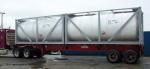
Tank Guru:  Please see attached chart of ISO tank container dimensions.  You will note that a 20′ tank container is actually 19′-10.5″ long from end-to-end (6058 mm).  The overall width is 8′ (2438 mm) and both of these dimensions refer to the distance from the outside faces of the corner castings.

A standard tank container is considered a “1CC” shipping container as defined by ISO 668 (https://en.wikipedia.org/wiki/ISO_668).  Center-to-center of the holes in the bottom castings are 5853mm and 2259mm, respectively for length and width.

Good luck!  We sell a lot of these portable tanks into storage service, because it’s hard to find the same value for a stainless steel, pressure-rated tank.
Video

TC Impact Approval

Question:  “I was wondering if you knew anything about the TC impact approved spec I saw recently stamped on tank containers?  I am trying to design into our new tracking device an impact monitoring capability.” 

Tank Guru:  Quoting from the UN Sub-Committee of Experts on the Transport of Dangerous Goods, the TC Impact Approved mark is “used to identify tank containers that are in compliance with a design that has been successfully tested at a test facility approved by the Canadian competent authority.”

What that means is that the tank container you saw (or more specifically, the prototype unit for that series of containers) was tested by the tank’s manufacturer for use on Canadian railroads, by virtue of completing of a rail impact test like this:  https://www.youtube.com/watch?v=yWeDwE_7gNU.

Once testing is completed successfully, the Class Society issuing the design approval on behalf of the manufacturer will send to Transport Canada (http://www.tc.gc.ca/) a “pre-notification of intent to mark portable tanks” which outlines the tank numbers for the entire series of tanks to be marked with the TC Impact Approved marking.  Tank containers are not allowed to be transported on Canadian railroads unless their capability to withstand impacts has been proven by this testing, and they must be marked accordingly.

80% filling ratio

Question:  “We have a customer that wants to load a 1.17 SG product in 24000 liter tanks.  Because the product will solidify in transport as it cools, a representative from one of the Class Societies said it would be OK. 

The problem we see is that once the product arrives overseas and is heated at a depot prior to being delivered to the customer, it will no longer be solid and we believe it will no longer meet the viscosity requirements in IMDG 4.2.1.9.6 that allow you to ignore the 80% fill rule.  But the Class Society representative says that the IMDG viscosity criteria is at 20° C, and since we are having to heat the product above 20° C in order for it to be viscous, therefore we are in luck.”

Tank Guru:  His logic makes sense; however it sounds like complying with the letter of the law but not the spirit of the law.  If the rule is there to prevent a dangerous slosh and surge situation, but you dodge the rule because ‘had the product been cooler it would have been less volatile’ — then good luck defending that position in a court of law if there is a rollover accident resulting in death or injuries.

I think you should convince your customer to use 21000 liter tanks, which will generally have a lower tare weight than larger tanks, and allow for slightly more payload anyway.      #CommonSenseSafety

painting tank frames and barrels

Question:  “What types of paint coatings should we put on our tank containers?”

Tank Guru:  The industry standard for ocean-going containers is a zinc-rich epoxy primer on any steel surfaces, like the framework on a tank container, followed by a top coat.  It goes without saying that surface preparation is everything, so first the steel surfaces must be abrasive-blasted or otherwise suitable prepared to receive the primer coat.  Follow the coating manufacturer’s instructions for thinning (if necessary), application thicknesses, re-coat times, etc.

A good acrylic enamel top coat, compatible with the primer coat and applied to customer color, should be all that is needed afterward.  These provide the best corrosion resistance in general and are used througout the conainer industry and available in a variety of colors.  A polyurethane top coat can also be used providing acceptable corrosion resistance and much better gloss retention.

A link to the RAL color codes is provided below.  If painting frame and barrel (stainless steel), then a different procedure would be used.  You are welcome to contact me with any further questions.

http://www.ralcolor.com/

more on food-grade tanks…

I had another question today about used food-grade tanks.  Now, “food-grade” can mean different things to different people — from sanitary tanks (with a polished interior) for milk or like products where bacteria is a concern, to tanks for ‘food-grade’ phosphoric acid or some other hazmat material.

But generally speaking in the intermodal tank world, a food-grade tank is simply a stainless steel tank container with a factory 2B finish that has never carried any chemical product, only edibles such as wine and spirits, corn syrup, etc. (not fish oil).

The issue is that if you want to purchase a food-grade tank, normally you will be buying a new tank rather than a used tank.  Reason being that at some point in the life cycle of a typical used tank, it was introduced into chemical service, especially here in the United States (transport of food products in tank containers is much more common in Europe) and therefore can no longer be considered food-grade.

So the question I got today was whether there are any options besides buying a new tank, and the answer is YES.  We have a process where we can take an ex-chemical tank, strip it of all valves and fittings and thermally clean it (heating interior to bake out impurities), then sandblast the interior and coat all wetted surfaces with a lining that is FDA approved for direct food contact.  Lastly we replace all valves with new stainless steel so that any wetted part is a virgin surface. 

This is a fairly expensive process, but still usually cheaper than purchasing a new tank, and of course involves less lead time than building a new tank.  So there you have it, “food” for thought!

container size and type codes

Question:  “Some of my tanks say T6 and some say T8.  What is the correct marking?”

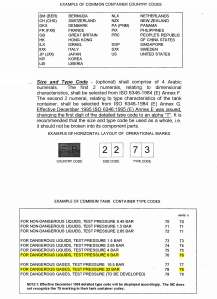
Tank Guru: If you are referring to the “Type Code” of the tank container, as in 22T6 or 22T8, it will depend on the pressure rating of the tank.  For a typical 4 bar MAWP chemical tank with a Test Pressure of 6 bar, the correct code would be T6 and would be appropriate for any tank with a Test Pressure equal to or greater than 6 bar, but less than 10.5 bar.

T8 (or 22T8) would normally be found on gas tanks.  And in the Size Code the first “2” indicates that it is a 20′ container, and the second “2” indicates the 8.5′ height.  See attached a more detailed explanation, courtesy of the now-defunct Tank Container Association.

container size and type codes.pdf

cladding for insulation required under Special Provision TP38

Question:  Do we need to use stainless steel cladding when insulating tanks with 4″ insulation (as required for PIH products)?”

Tank Guru:  The insulation requirement for toxic products which are considered an inhalation hazard (special provision TP38) is as follows:  “Each portable tank must be insulated with an insulating material so that the overall thermal conductance at 15.5 °C (60 °F) is no more than 1.5333 kilojoules per hour per square meter per degree Celsius (0.075 Btu per hour per square foot per degree Fahrenheit) temperature differential. Insulating materials may not promote corrosion to steel when wet.”

In the simplest terms, 100mm (4″) of any of the normal insulating materials used on tank containers (mineral wool, fiberglass, polyurethane, etc.) more than meets the requirement.  And while it is most common to see tanks carrying PIH products with SS cladding, this is not required and any jacketing material will work.

ITCO Tank Container Village


ITCO - TL 2009

rupture disc burst pressure

Question:  What is the correct burst pressure for a 4 bar tank?  Should we install a 4.4 bar rupture disc?”

Tank Guru:  The Pressure Relief Requirements for most common tank containers are stated in Section 178.275(g) of Title 49 of the Code of Federal Regulations (also known as ‘49 CFR’).  This covers tank types T12, T14, and T20, as well as older IM-101/IMO Type 1 tanks.   

178.275 (g) 3 states “The frangible disc must rupture at a nominal pressure 10% above the start-to-discharge pressure of the reclosable pressure relief device.”   

178.275 (g) 6 Setting of pressure relief devices… states “and 110% of two-thirds of the test pressure for shells having a test pressure of more than 4.5 bar…  A self-closing relief device must close at a pressure not more than 10% below the pressure at which the discharge starts.”   

So in the typical example where a normal “fleet-type” T11 tank has Test Pressure of 6 bar (or MAWP of 4 bar), and the Pressure Relief Device has a set-to-discharge pressure of 4.4 bar (110% of two-thirds of the test pressure); when a bursting disc is installed (actually making it become a T12 tank) the burst pressure of the rupture disc should be 10% higher than the 4.4 bar set pressure of the PRV.  Therefore you should actually be installing rupture discs with a burst pressure of 4.84 bar, not 4.4 bar.

corrosion allowance

Question:  I inspected a 1987 Consani tank.  I have a question about minimum thickness on IM-101 tank barrels.  The data plate said the thickness was 4.8mm (equivalent to 6.35mm steel).  I did not see a note that any corrosion allowance was built in.  What is the minimum thickness of this tank?  I took some readings and want to make sure the barrel is thick enough.  Any other items I should note about this 1987 Consani model?”

TankGuru:  In general, tank containers have very little corrosion allowance built in.  What the data plate is telling you is that the tank was built with shell material that was 4.8mm actual thickness (before forming), equating to a Mild Steel Equivalence of 6.35mm.  The head material will undoubtedly have a greater nominal thickness as this is likely a 4 bar MAWP tank, and the heads would have to be thicker in order to maintain the same MSE, not to mention in order to handle the 4 bar pressure rating, due to the thinning that occurs during head forming.

The latter number of 6.35mm is important because the IMDG regulations specified what MSE thickness was required for carriage of different products (for example: 6mm MSE, 8mm MSE, etc., depending on how hazardous the product is).  Most of the tanks of that vintage had a 6.35mm MSE and were constructed of 3/16″ shell material Type 316L or equivalent, with 1/4″ thick heads (again, nominal thickness prior to forming).

1987 Consani tanks were well-built in general, but considered heavy in terms of their tare weight as compared to other (newer) tank containers.  We have sold a number of these units, and my guess is that you are looking at a 23000 liter tank with a tare weight of approximately 10,000 lbs.  If the shell thickness readings are comparable to the original values and the tank passes a hydro test at its full Test Pressure of 6 bar, the only thing that I would be concerned about (if it is important to you) is having a working steam system in a tank that is 22 years old.